Start with what you actually use
Pull every spice out of the cupboard and put it on the table. Yes, all of it. Now split the jars into three groups: the ones you used this week, the ones you used this season, and the ones you cannot remember buying. For most people who cook tacos regularly, the first group is small — cumin, a chilli powder or two, smoked paprika, dried oregano (Mexican oregano if you have it), garlic powder and perhaps ground coriander. That short list is your front row.
The second group goes behind it or on a higher tier. The third group gets a sniff test. Ground spices lose aroma over time, usually noticeably within a year or two, while whole seeds such as cumin, coriander and allspice hold their character longer. If a jar smells of dust instead of spice, it will taste of very little in the pan. Compost it and free up the space.
Pick a home based on your kitchen, not a catalogue
Small kitchens rarely have a perfect spice spot, so choose the least-bad option for the way you move. Stand at the hob, hold out your arm and turn ninety degrees each way. The area you can reach without stepping is your target zone. Then rule out anything directly above the burners: steam, grease and heat shorten a spice's life, which is why food writers from Harold McGee onwards keep repeating the same advice to store spices somewhere cool, dark and dry.
Drawer inserts
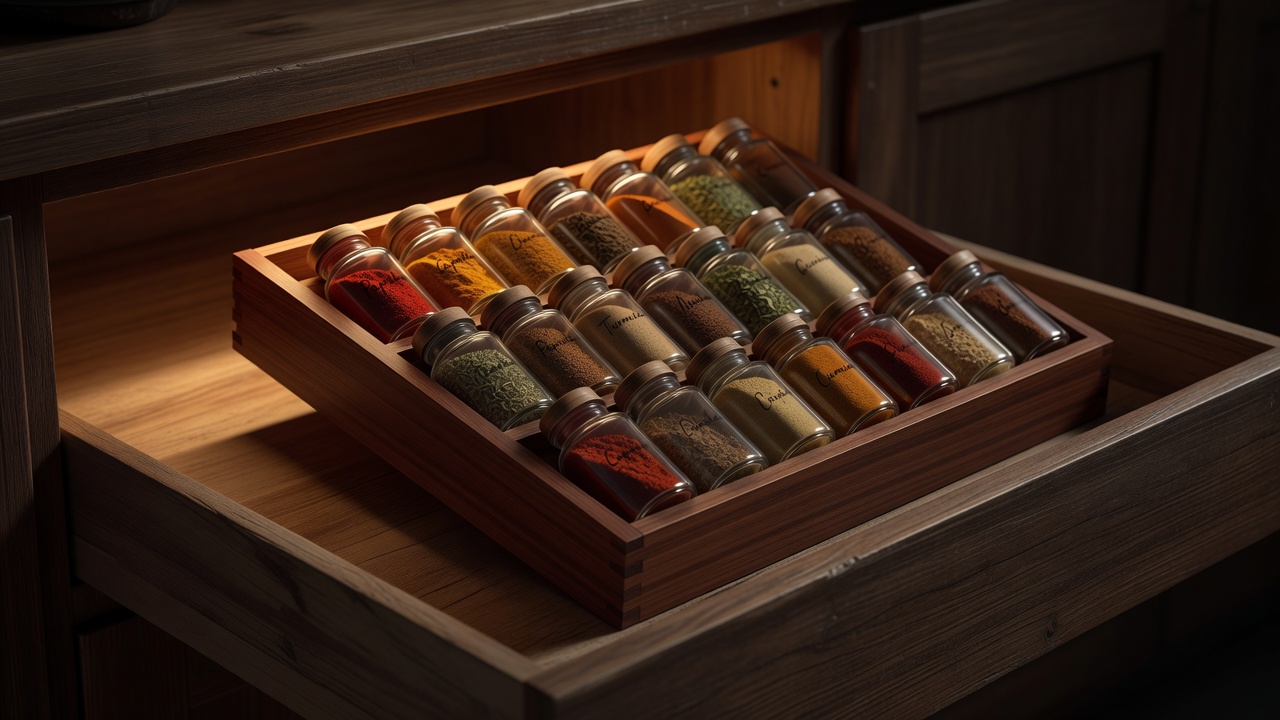
If you have a shallow drawer beside the cooker, an angled insert is the fastest system there is. Jars lie at a slant, lids facing up, and you read every label in a single glance. Write the name on the lid with a paint pen or a printed label. Side labels are useless in a drawer.
Cupboard risers and turntables
In a wall cupboard, a two- or three-tier stepped riser lifts back rows into view. A turntable — the classic lazy Susan — works well in deep corner cupboards, but keep it to one ring of jars so you are not spinning past things you never use.
Door racks and wall rails
The inside of a cupboard door holds a surprising number of small jars. Measure the gap between the door and the shelf edge first, so the rack does not stop the door closing. Wall rails and magnetic tins are useful in galley kitchens with no spare drawer, as long as the spot avoids direct sunlight.
Order jars by sequence, then by frequency
Alphabetical order looks tidy but costs time. Instead, group by when the spice enters the pan. For a typical taco filling, onion and garlic go in first, then the ground spices bloom in the oil, then dried herbs and finishing touches come later. Keep that sequence left to right in the front row. Behind it, line up the occasional jars — cinnamon for a mole-style sauce, cloves, bay leaves, dried ancho or chipotle.
Label so anyone can cook
Use one label style throughout: same font size, same position. Add the date you filled the jar in small print. When a partner, child or guest cooks, they should be able to find the chilli without opening every lid. Matching jars help, but they are not essential; matching labels do more of the work.
Refill without the mess
Buy smaller packets more often rather than huge bags that go stale. Keep a narrow funnel with the refill packets in a lidded box on a higher shelf — the backstock zone. When a front jar drops below a quarter, refill it from the box and note on your shopping list if the backstock is running out. That habit, borrowed from the first-in, first-out (FIFO) rotation used in professional kitchens, keeps older stock moving to the front.
Check the route
Cook one taco night with the new layout. If you still step away from the pan to fetch a jar, move it. Organisation is not a single makeover; it is a few rounds of small adjustments until the route feels automatic. When it does, move on to the next stop: tortilla storage.