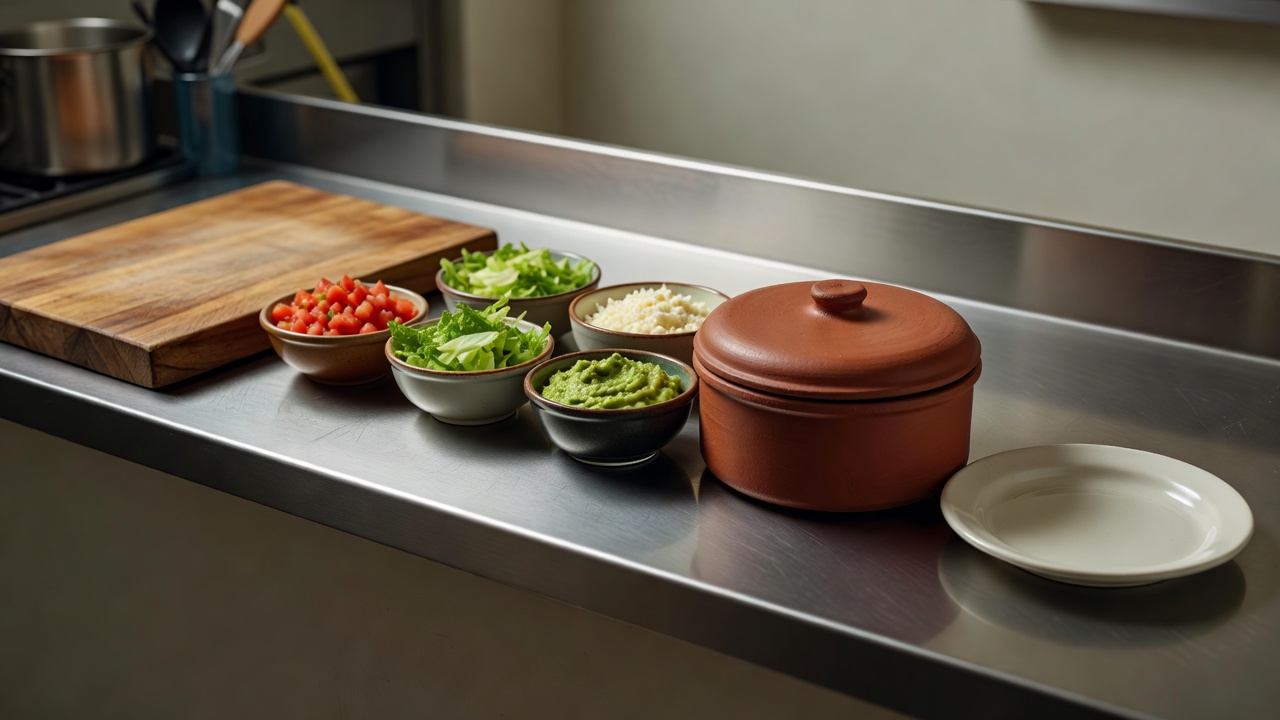
Begin with mise en place
Professional cooks have a name for this: mise en place, French for "everything in its place", a discipline associated with Auguste Escoffier's brigade kitchens. In a small home kitchen, it matters even more. When every ingredient is chopped and waiting before the pan gets hot, you are never hunting for the lime while the onions burn.
Prep in the same order you will assemble. Chop the onion first, then the coriander, then cut limes, then spoon salsa into its bowl and grate the cheese. Each bowl takes its place on the line as soon as it is filled, and the board is clear for the next task before you light the hob.
Measure the counter you really have
Clear the counter completely and measure the longest unbroken stretch. Kettles, toasters, fruit bowls and the utensil crock are the usual culprits eating space. Move anything that is not used every day to a cupboard or a shelf above. Many small-kitchen cooks discover they had nearly a metre of usable surface hidden under appliances.
If you truly have less than 60 cm, extend it. An over-sink chopping board, a fold-down wall shelf, a pull-out board above a drawer or a sturdy trolley each add a temporary surface that disappears after dinner.
Line the bowls in assembly order
Five small bowls are plenty. Pick shallow ones so you can see what is inside and spoon from them easily. Matching bowls stack and nest in the cupboard as a single unit, which keeps the reset quick. Put wet ingredients like salsa and pickled onion on a small plate or tray to catch drips.
A simple, flexible line
- Diced white onion and chopped coriander (often mixed together)
- Salsa — a quick pico de gallo or a cooked red salsa
- Lime wedges
- Crumbled or grated cheese, or sliced radish for crunch
- Something creamy: avocado, guacamole or soured cream
Share the hob in turns
A two-ring hob is not a limit if you plan the order. Cook the filling first on the front ring. While it rests with a lid on, heat tortillas on a dry pan or comal and move them to the warmer. Then return the filling to the heat for a minute before serving. Batch-warming tortillas into an insulated warmer frees the second ring for beans or a quick salsa.
Keep tools within the station
Give the station its own small caddy: one sharp knife, a citrus squeezer, a tongs set, a spoon for each wet bowl and a pastry brush for oiling the pan. Store the caddy in the drawer nearest the board. Rick Bayless and other cooks who teach Mexican home cooking often stress how few tools you truly need; the trick is knowing exactly where they are.
Prep onto a tray, serve at the table
Place the bowl line on a large sheet tray. When the filling is ready, the whole tray goes to the table and everyone builds their own. Your counter is cleared instantly, the cook can sit down, and the clean-up starts with one tray instead of a scattered counter.
Walk it once, then adjust
After your first run, ask three questions: where did I stop, where did I reach across, and what did I fetch twice? Fix one thing each week. In a month, the route will feel automatic — and it all starts with a readable pantry feeding the line.